Saturday, April 19, 2008

Our Last Night in Rome

Tonight we joined the students and other teachers in the Loyola/CUA Rome program to say goodbye to Rome.
We are anxious to see everyone back in Baltimore (especially Dijle), but we are sad to be leaving our home on Baloney Alley:
As we learned when we left Belgium, in such situations mixed feelings are the best possible scenario: sad to be leaving where you are, but happy to be returning to where you were.
And now for a little sleep, before our 5:30 AM cab to the airport.

--Fritz

Friday, April 18, 2008

Defend the Fort

Two days ago my dad and I went to Castel Sant Angelo. First we went through a tunnel that led to the mausoleum of the Emperor Hadrian. Then we went into the mausoleum.

Then we saw the urns that the burnt emperors were put in, but I am yet to be burnt.

This is what they would shoot at enemies.Then we got a nice view.

Then we got a nicer view.
Then we got the best view.
Then we saw the angel on top and he was really big.
Then we saw the angel that was on top first. He was a better fighter.

Then my dad, being my dad, had to go into every church he sees, and the Medici chapel counted.

Then we went on the wall.

Then we saw a blacksmiths shop that, of course, had a cannon.

Then we saw the she-wolf graffitied on the side of the Tiber.
Then I was Romulus.

Denis

Tuesday, April 15, 2008

Sunrise Over Rome

Early this morning, I was woken from a dream of a delicious baklava-like dessert in order to climb the great Gianicolo and photograph the sunrise. My dad and I went together and we were both a little daunted by the clouds in the East (and West, for that matter), but they turned out to be quite the addition to our pictures.

I'll let the pictures speak for themselves.


**Sophie

Monday, April 14, 2008

Requiem: The Graveyard at San Miniato

As I mentioned in the post about our visit to Florence, one thing we did was to hike up to the church of San Mineato. While there, we spent some time looking around the graveyeard, which is filled with remarkable monumental tombs. What is remarkable is not so much the artistic quality -- indeed, some boarder on the kitschy -- but the eloquent outpouring of emotion they represent in both word and image.

Looking through them, one senses the joys and sorrows that constituted these lives, as well as the joys and sorrows of those they left behind.

And in some of them one gains a palpable sense of clinging to Christ in faith.
--Fritz

Saturday, April 12, 2008

FREAK JOB!!!


for M

Firenze

We made a quick overnight trip to Florence on Thursday and Friday, trying to cram in a last little bit of Italian culture. Our first stop was Santa Maria Novella, which contains Masaccio's stunning Trinity fresco. It also contains a less well known set of frescoes by Filipino Lippi, one of which includes a charming depiction of a dragon farting:
We then went by the Orsanmichele -- a former grain storage facility that over time morphed into a church. In keeping with the dragon theme, we admired Donatello's St. George: We also puzzled over this image that was part of a set depicting the various guilds in the city:
At first we thought it might be for the brain surgeons' guild, and this was some sort of primitive brain surgery done with a pick. But then we realized that the child was a statue and that this was for the stone carvers.

After this we went to the Science Museum. Unfortunately, most of it was closed for refurbishing. We did get to see the exhibit on Galileo's telescope, as well as this cool clock:

We also stopped by Dante's house:

Near it is the church he attended, where his Beatrice is buried. There are baskets of petitions by her grave; I guess she's been informally canonized:

After lunch we went to the Duomo area, first passing by a workshop where they repair and make reproductions of the Cathedral's sculptures:
Maureen and the children climbed the Dome; I thought I'd give my creaky old knees a rest:

We went to the much under-appreciated Museo del Opera del Duomo, that has many of the original sculptures from the Duomo, baptistry and campanile:A personal favorite of me and Maureen is Donatello's prophet Habakkuk, known as Il Zuccone or, more or less, "Pumpkin Head":

Also by Donatello is his harrowing Mary Magdalene, which depicts her near the end of her life, after years in the desert:

The museum also contains Ghiberti's original panels from the east doors of the baptisty, which Michelangelo dubbed "The Gates of Paradise":

A personal favorite is this depiction of John the Evangelist, that looks strikingly like Russ Eidson, my friend from highschool:

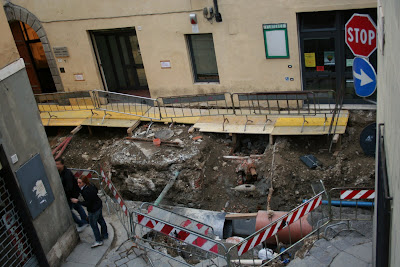
Footsore and filled to the brim with culture, we retired to our hotel, the wonderful Nuova Italia run by the Viti family. It was where we stayed when we would bring students from Belgium and it was nice to be able to come back to a semi-familiar place. Unfourtunately, the street was torn up with sewer work and there was an, um, distict odor in the air outside.
For dinner Denis got the biggest Florentine steak you've ever seen. Thomas and I split one.

The next day we started out at the Uffizi, which is overwhelming. By the end of two-and-a-half hours we were punch-drunk with art. They don't allow you to take pictures of the paintings, so we bought postcards and took pictures of them:

In order to counteract the effects of too much art, the family did the Hokey Pokey on the Ponte Veccio (or at least that's what it looks like):

On the other side of the Arno river, Thomas got pasta with lobster for lunch, which he approved of:We also discovered a Pinocchio shop:We spent the afternoon walking up to the church of San Miniato, which provided the great views of the city:The church itself is very nice, and has a very cool graveyard, that I'll blog about separately:Back in Florence in the early evening, we did a bit of street shopping:

And Sophie and Denis and I took a quick look inside the Duomo baptistry, which has a spectaular ceiling:After a quick dinner, we caught our train back to Rome, just a little bit tired.

--Fritz

Wednesday, April 9, 2008

Wonderful, revolting cheese


Just thought we'd share with you the repulsive-looking lump of thoroughly delicious cheese we had for breakfast this morning -- a "rustic" goat cheese that was wonderful once you took a deep breath and convinced yourself to put something that icky and slimey-looking in your mouth. Mmmm.

Maureen

Tuesday, April 8, 2008

San Clemente

This past week I had an opportunity to do twice something I had not yet done during our current stay in Rome: visit the church of San Clemente. Last Friday Maureen, Denis and I went with our friend Marianne, and again today Denis, Thomas, Sophie and I went with Laura Flusche's Roman Art and Architecture class.

San Clemente is perhaps my favorite church in Rome, in part because it is something of a metaphor for the city itself. The church, named for the fourth Pope, was built around 1100 on top of a 4th century church (also called San Clemente) that had been burned by the Normans, and then filled with dirt and rubble to form the site of the new church. That 4th century church was itself build over 1st century ruins, containing a warehouse and a house that, probably in the 2nd century, had been turned into a center for the cult of the god Mithras. It was not until the late 19th century that the Irish Dominicans who staff the church figured out that the original church must be under the one from the 1100s and began excavating.

It's all somewhat hard to picture, but its a bit like going on a trip back through time as you descend though the layers. One gets a bit of a sense of just how long Rome has been around and how its exists layer upon layer. I hope these photos will give some impression of what it's like.
The entry to San Clemente from the street.

Inside the atrium, which offered a respite from the busy medieval streets before entering the church.

The interior of the church built in the 1100s, now somewhat baroquified.

The spectacular apse of the upper church.

A crucifix in the upper church.

The excavation of the 4th century church (with a restored 19th century altar).

To support the church built in the 1100s, supporting walls were built around the columns in the ruins of the 4th century before it was filled in.

A fresco from the 1000s in the remains of the 4th century church, painted not too long before it was burned, depicting St. Clement.

Also in the 4th-century excavations is the grave of Leonard Boyle, OP, former prefect of the Vatican Library and, more importantly, one of the few people in the world who could read Thomas Aquinas' handwriting!

Down on the 1st century level: the altar to the god Mithras.

Dr. Laura Flusche, teaching in the first century.

--Fritz

Uncle Clayt gets the last word

A last poetic word from Uncle Clayt, who left with Papa/Dad this morning after a great visit:


Stalking yellow cat
A pigeon feast eludes him
Dry cat food for him

Beautiful poem
Words of such grace and beauty
Even Denis weeps

CAS, Jr.

Monday, April 7, 2008

Haiku-off

My father and brother, the Claytons Sweeney, are here with us for a few days. We have had a great time taking them around Rome and sharing with them things that we have learned. Sophie gave a terrific tour of the Baths of Caracalla, and Denis did a great explanation of the interesting things we've learned about the Pantheon (like despite the fact that it says on the front of it "Agrippa made this," Agrippa didn't make it -- Hadrian did; and other even more interesting facts).

Clayt (Jr.) is staying with us, and this morning, inspired by the haikus on our homeschool wall, he composed this haiku about the scene off our terrace:

Rooftop oven racks
Romans watch cooking shows?
Or cook with TV?
CAS, Jr.

When he came back in, he was further inspired to write a couple more haikus about Denis' morning, and Denis then replied. The result was the following exchange. Maybe you can figure out who wrote which parts.

Denis Morning
by Clayton Sweeney, Jr. and Denis Bauerschmidt Sweeney

Chimp child does not eat
Differently directed
Energy won't last.

Chocolate chimp breakfast
Sandwiched apple rosetta
Half eaten, half worn.

Chimp be greatest one.
He pwns at all, everything.
Go super-chimp-guy.

Uncle not inspired
He won't write anymore nonsense
Mom make me eat now.

Uninspired Uncle
Who generates entropy
Cannot focus chimp.

Writer stinks at all
Except the one who writes this,
Stanza 3 and 4.

Bu-a-ha-ha-ha
Chimp child plots uncle's demise.
Uncle lays in wait.

I win cause of arms.
I will bash out your stanzas.
Mwa-ha-ha-ha-ha.

Mwa-ha-ha-ha-ha.
Mwa-ha-ha-ha-ha-ha-ha.
Mwa-ha-ha-ha-ha.

Uncle-allied parents
Give uncle an advantage.
Chimp child must find sock.

No sock? I don't care.
I battle socks or no socks.
I am without fear.

Now we fight again
Fight again at the Forum.
Again I shall win.

Slightly focused chimp
Energy without limit
Venit, me vincit.

Sissy-ful uncle
He runs at the sight of me
Victorious chimp.

The haiku-athon continued through the morning and through the city as we visited the Pantheon, the Roman Forum, and the Colosseum. A selection:

Walking past a ruin
Pantheon, not Parthenon
Squashed bird in the road.
CAS, Jr.

Pigeons peck at bread.
They can never finish it
For they only peck.
DJBS

Italiano
Io mangio, mangio, mangio.
Mi faccio grasso.
CAS, Jr.

The warmth of the stone
Feels good to the hand and touch
On a windy day.
DJBS

Throbbing feet and back
Pizza salves the savage beast.
Chimp not beast, not salved.
CAS, Jr.

Doric, Ionic
Corinthian columnae
Don't fall on my head.
CAS, Jr.

Salivating chimp
A dead enemy smells good.
Chimp boy uncle breath.
CAS, Jr.

Uncle stinks haiku
Chimp is the god of haiku
Who is the winner?
DJBS

You get the idea. In the end, Clayt Sr., also known as Papa/Dad, even joined in:
Now it is my turn
To laugh and cry and speak now.
Two can play this game.
CAS, Sr.

We hope you have enjoyed this literary moment, brought to you by the American Association of English Majors, who remind you how much fun literature can be.

Maureen

Sunday, April 6, 2008

Sorrento

We spent the weekend before last (the 29th and the 30th) in the town of Sorrento, on the southern tip of the Bay of Naples. We piled onto a bus at eight thirty in the morning, greeted by everyone's favorite busdriver, Giuseppe, and headed off on a three hour bus ride to Naples. We arrived in Naples, and spent a whirlwind six hours seeing as much as we could (see my dad's post below for more details). We then got back on the bus for a two hour drive to Sorrento. Driving around the bay, we saw one of the more beautiful sunsets I have ever seen. As we wound our way along the streets, shifting between closely packed houses and scenic views of the Mediterranean with the sun sinking lower and lower, reflecting bright orange off the water, we were informed by David Dawson-Vasquez, the program director, that there was an Irish pub and a karaoke night at another local bar.


We checked into the hotel, and were told we had a half hour until dinner. The half hour was largely spent discovering that we all had balconies that connected to each other. When we were finished on the balcony, it was time for dinner, so we all headed up to the dining room, where I sat with three of the students, Tom, AJ, and Betsy. Denis sat at a table with three other students, and Sophie decided to stay with our parents. Dinner was a huge, multi-course affair, consisting of pasta, chicken, potatoes and dessert. As dinner drew to a close, I asked if I could go with the students to the karaoke bar. They said sure, and so a half hour or so later, we all followed David into town.

It turned out that there wasn't actually karaoke that night, but we had a good time anyway. The next morning, we woke up and went to Pompeii (See Denis' entry below for more details). When we came back, we decided not to try and catch a ferry to the nearby island of Capri, and instead enjoyed a leisurely lunch with David, and then went for a walk down to the shore. While Denis only got a little wet playing in the sand, Sophie felt a need to wade into the painfully cold Mediterranean, and got her pants thoroughly wet before we went into town to look at some of the inlaid woodwork that Sorrento is famous for. We then went to Mass in one of the coldest churches I have ever been in. Despite the cold, Sophie, Denis, and I all kept nodding off during the homily. After Mass, we went back to the hotel in time for Sophie to change, and went up to dinner.

At dinner, our family dispersed among the students. Tom, Betsy, and I were once again sitting at the same table, and we were joined towards the end of the meal by Sophie. After dinner, we went back to our rooms, where we watched part of a House episode, dubbed in Italian. I then went down to another room, and hung out with the students for a few hours, while the rest of my family went to sleep.

The next morning, we woke up, ate breakfast, and went to the bufala farm (see Sophie's entry below for more details),before turning home.As we drove back to Rome, I realized how much I had enjoyed the last few days. I don't know if it was the beautiful, peaceful town, or the fact that I was able to hang out with people who were not family members, spoke English, and were between the ages of fifteen and thirty, or some of both, but I think that it was the best couple of days I have spent since we came to Italy.

Thomas

Bufala (*squeal!*)


Last weekend, we went (on the way back from the Bay of Naples) to a "Bufala" farm, where water buffalo are raised and their milk is used to make bufala mozzarella.
Our tour began in the last stages of the mozzarella making process, then moved back, so we went first to the room where the milk is turned into cheese and the cheese is salted and packaged. After that, we moved on to the animals, where Denis got sneezed on by a buffalo.

Every time we moved on to a new group of animals, a large number of the college students (always girls, I believe) squealed. First we saw the milkable cows- buffalo cows, not the black and white variety (squeal). After that, we saw the pregnant cows (slightly louder squeal) and the first time pregnant cows (still louder and shriller squeal).

Next came the 6 month old babies (squeals so loud and frequent that the poor buffalo were rather startled), then the 3- to 15-day-olds (you guessed it- squeals).
After the buffalo, we visited the piglets, then sat down to a huge and delicious lunch (consisting, as all proper Italian meals do, of an appetizer, pasta course, meat course, and desert).

After lunch, we got to wander around for a while (Denis and I raced through a field of knee high grass and visited the horses and donkeys), then we got back on the bus and left.


**Sophie

Friday, April 4, 2008

Pompeii


When we went to see Pompeii with my dad's students and Dr. Flusche the ancient art and architecture teacher. We first went to the large theatre which was used for plays. Most theatres used for plays had a fake palace facade so it would set the scene for many of the plays. Then we went to the small theatre which was used for musical performances. After that we went to an ancient bar. The wine sure had fermented. Then we went to the door of a big house of a senator. Then Dr. Flusche told us about how being an ancient Roman senator was like being an ancient Tony Soprano. When you do somone a favor they owe you a favor. Then we went to the forum. It was alot like the forum in Rome but much smaller (and if Vesuvius erupts and you want to watch, go there). Finally we went to the house of the fawn. It was really big.


Denis, The Buried in Ash Majority of Doom

Naples

We did a number of things on our trip south with the Loyola/CUA students, and I'll let others in the family fill in some parts, but I thought I'd say a few quick things about our afternoon in Naples.

Naples has a reputation in Italy as. . . well. . . excessive. Everything Rome is, particularly the negative things, are supposedly magnified in Naples: big, dirty, noisy, bustling etc.

It's hard to judge a city on a single afternoon, but it certainly felt different from Rome -- more Mediterranean, I suppose. Maureen said that with its crowded, narrow, chaotic streets it had an almost third world feel too it. I'm sure the Neapolitans wouldn't like that characterization, but something about it rang true to me.
We arrived in the late morning and did a quick walking tour of the historic center, including a palace that the Jesuits (naturally) had turned into a church.
We had a lunch of unbelievably good pizza (a Neapolitan invention) that made Denis sad because he said that now he would never like pizza in America again. Then we browsed in the various shops, which had peculiar Punch (as in Punch and Judy) figures that we supposed to bring good luck (this one apparently brings pizza as well), strange figurines that seemed to be people being consumed in the fires of hell, and the famous Neapolitan Christmas creche figurines, including US presidential candidate to put next to baby Jesus.
Late in the afternoon we toured the incredible collection in the Archaeological Museum, ably guided by Dr. Laura Flusche, who teaches art and architecture to the Loyola/CUA students in Rome.


The Museum contained many artifacts from the Baths of Caracalla in Rome, which were expropriated by the Farnese family in the 16th century and eventually ended up in Naples. Particularly striking were two sculptures of young boys running

and the famous Farnese Bull:

The other highlights were the artifacts from Pompeii. Particularly magnificent was the mosaic of Alexander the Great defeating Darius of Persia.
After that we headed off around the Bay of Naples, seeing some of the famous Neapolitan garbage along the way. We arrived in Sorrento and continued our adventures, but I'll let someone else tell that part of the story.

--Fritz

Wednesday, April 2, 2008

More Popery

Our friend Marianne Servaas has been visiting from Belgium and today she and I went to the memorial Mass in St. Peter's square for the third anniversary of John Paul II's death. I think after the Easter Vigil the rest of the family is Poped out for the time being. In any case, the Mass was quite moving and very simple. . . or as simple as a Mass with 50,000 people can be. Whatever one thought of him (and I rather liked him, myself), John Paul was a larger-than-life figure and one worth remembering (and praying for, like all of us). I also always like being surrounded by the vast, diverse sea of Catholicism. Communion seemed more chaotic than usual and I was feeling pretty grumpy about that. But then I saw a young Asian man coming back from communion with tears streaming down his face. On the presumption that he wasn't crying because someone had stomped on his foot in the communion scrum, but rather in gratitude for what he had received, it made me appreciate the event despite the communion chaos.


Here's an AP photo of the event:

I've searched the faces in the crowd, and I'm pretty sure I don't appear. But I swear I was there.

--Fritz