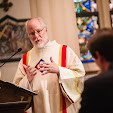
We made a quick overnight trip to Florence on Thursday and Friday, trying to cram in a last little bit of Italian culture. Our first stop was Santa Maria Novella, which contains Masaccio's stunning
Trinity fresco. It also contains a less well known set of frescoes by Filipino Lippi, one of which includes a charming depiction of a dragon farting:

We then went by the Orsanmichele -- a former grain storage facility that over time morphed into a church. In keeping with the dragon theme, we admired Donatello's St. George:

We also puzzled over this image that was part of a set depicting the various guilds in the city:

At first we thought it might be for the brain surgeons' guild, and this was some sort of primitive brain surgery done with a pick. But then we realized that the child was a statue and that this was for the stone carvers.
After this we went to the Science Museum. Unfortunately, most of it was closed for refurbishing. We did get to see the exhibit on Galileo's telescope, as well as this cool clock: 
We also stopped by Dante's house:
Near it is the church he attended, where his Beatrice is buried. There are baskets of petitions by her grave; I guess she's been informally canonized:
After lunch we went to the Duomo area, first passing by a workshop where they repair and make reproductions of the Cathedral's sculptures: 
 Maureen and the children climbed the Dome; I thought I'd give my creaky old knees a rest:
 We went to the much under-appreciated Museo del Opera del Duomo, that has many of the original sculptures from the Duomo, baptistry and campanile:
 A personal favorite of me and Maureen is Donatello's prophet Habakkuk, known as Il Zuccone or, more or less, "Pumpkin Head":

Also by Donatello is his harrowing Mary Magdalene, which depicts her near the end of her life, after years in the desert:
The museum also contains Ghiberti's original panels from the east doors of the baptisty, which Michelangelo dubbed "The Gates of Paradise":
A personal favorite is this depiction of John the Evangelist, that looks strikingly like Russ Eidson, my friend from highschool:
Footsore and filled to the brim with culture, we retired to our hotel, the wonderful Nuova Italia run by the Viti family. It was where we stayed when we would bring students from Belgium and it was nice to be able to come back to a semi-familiar place. Unfourtunately, the street was torn up with sewer work and there was an, um, distict odor in the air outside.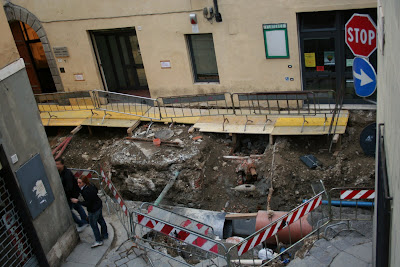
For dinner Denis got the biggest Florentine steak you've ever seen. Thomas and I split one.
The next day we started out at the Uffizi, which is overwhelming.  By the end of two-and-a-half hours we were punch-drunk with art. They don't allow you to take pictures of the paintings, so we bought postcards and took pictures of them:

In order to counteract the effects of too much art, the family did the Hokey Pokey on the Ponte Veccio (or at least that's what it looks like):
On the other side of the Arno river, Thomas got pasta with lobster for lunch, which he approved of: We also discovered a Pinocchio shop:
 We spent the afternoon walking up to the church of San Miniato, which provided the great views of the city:

 The church itself is very nice, and has a very cool graveyard, that I'll blog about separately:
 Back in Florence in the early evening, we did a bit of street shopping:
And Sophie and Denis and I took a quick look inside the Duomo baptistry, which has a spectaular ceiling: After a quick dinner, we caught our train back to Rome, just a little bit tired.
--Fritz


 As we learned when we left Belgium, in such situations mixed feelings are the best possible scenario: sad to be leaving where you are, but happy to be returning to where you were.

 As I mentioned in the post about our visit to Florence, one thing we did was to hike up to the church of San Mineato. While there, we spent some time looking around the graveyeard, which is filled with remarkable monumental tombs.

 What is remarkable is not so much the artistic quality -- indeed, some boarder on the kitschy -- but the eloquent outpouring of emotion they represent in both word and image.


 The entry to San Clemente from the street.


 Dr. Laura Flusche, teaching in the first century.